Why should Azadari Media exist in a world of YouTube and Spotify?
Preserving Azadari is not just about preserving content. It is about recognising the people, their contributions, their identities and the legacy they create.
We live in a world where almost everything is available at our fingertips.
YouTube lets us watch videos from anywhere in the world. Spotify lets us listen to millions of songs. Instagram helps artists reach audiences, and digital platforms have made publishing easier than ever.
So, in a world where YouTube and Spotify already exist, why should Azadari Media exist?
It is a fair question. Perhaps the answer lies in understanding what these platforms were built to do, and what they were never designed to do.
The content exists. But is it organised?
Over the years, Azadari has grown through the contributions of countless people: reciters who dedicate their voices, poets who write kalam, composers who create melodies, studios that bring recordings to life, production houses that produce albums, and many others working behind the scenes.
Their work reaches millions of people through YouTube, Spotify and other platforms. But something is missing.
Where is the organised identity of these contributors? Where can someone discover a poet’s complete body of work? Where can a reciter showcase their professional journey? Where can a production house present its projects and services? Where can someone planning a Muharram album find the right people to work with?
Today, these connections are scattered across social media accounts, YouTube descriptions, WhatsApp conversations and personal contacts.
The content is available. The contributors exist. The talent is everywhere. But the ecosystem connecting them is fragmented.
Alongside YouTube and Spotify, not instead of them
Azadari Media does not exist to replace YouTube or Spotify. These platforms play an important role in making content accessible to the world. Streaming, watching and listening are already well served.
For Azadari Media, streaming is an option, not the entire vision. Our purpose is different: a connected digital ecosystem where every person contributing to Azadari has an identity, a portfolio and the chance to connect with others.
Because a nauha is more than an audio or video file. Behind every nauha there is a poet, a reciter, a composer, a studio and often an entire production team. Every contribution deserves recognition.
Giving identity to everyone
Imagine a world where every contributor to Azadari has a dedicated digital identity.
Reciters (nauha khwan)
A place to showcase their nohay, albums, performances, collaborations and professional journey.
Poets (shayar)
A portfolio of their kalam, published works, literary contributions and collaborations.
Composers
A place to showcase their compositions, musical work and creative portfolio.
Studios
A professional presence for their recording facilities, past projects, services and capabilities.
Production houses
A platform for their productions, teams, albums and creative services.
The unseen hands
Not only the most visible names, but also the people whose contributions often go unnoticed.
A page for every role behind a nauha
Each profile collects someone’s complete work and links it back to every nauha they touched. These are real pages, live today.
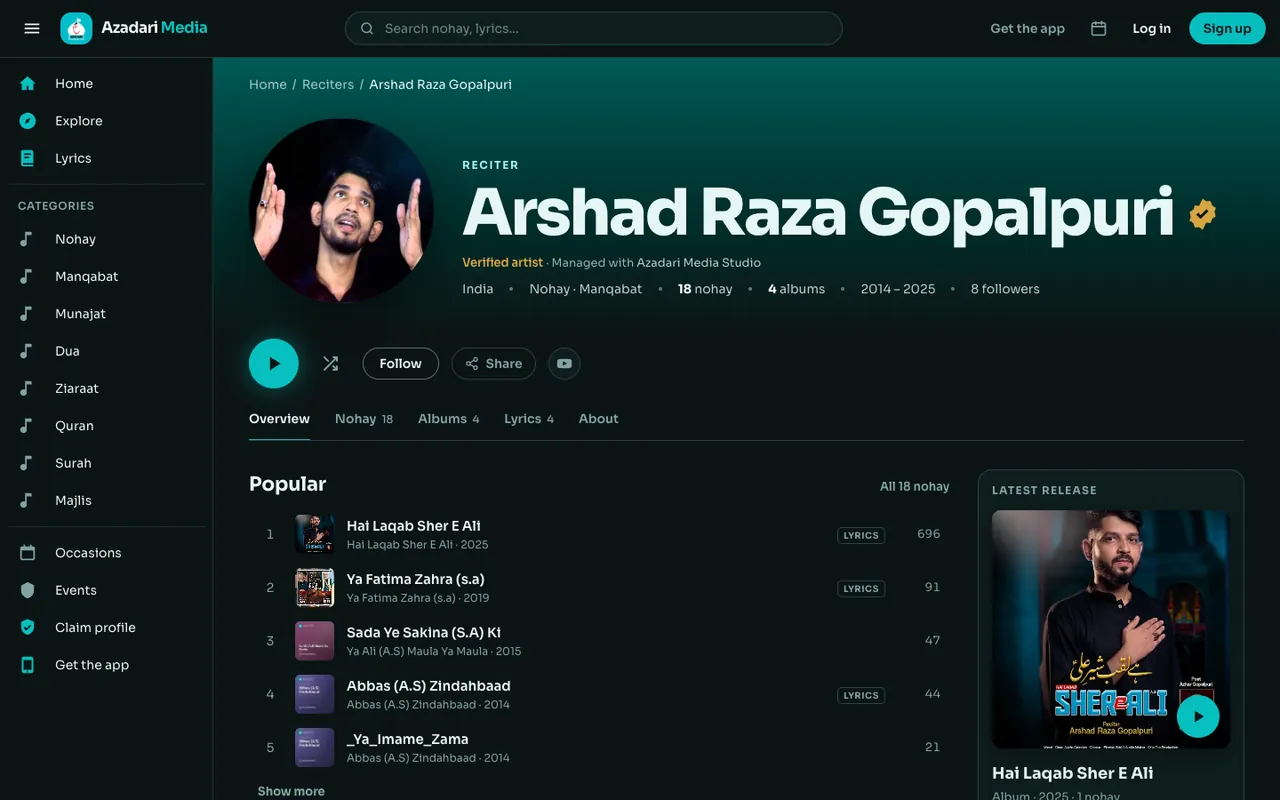
Reciters: one profile, complete work
Every nauha and album in one place, by year, with followers, a verified badge and a Book Me button when the reciter turns it on.
See a real example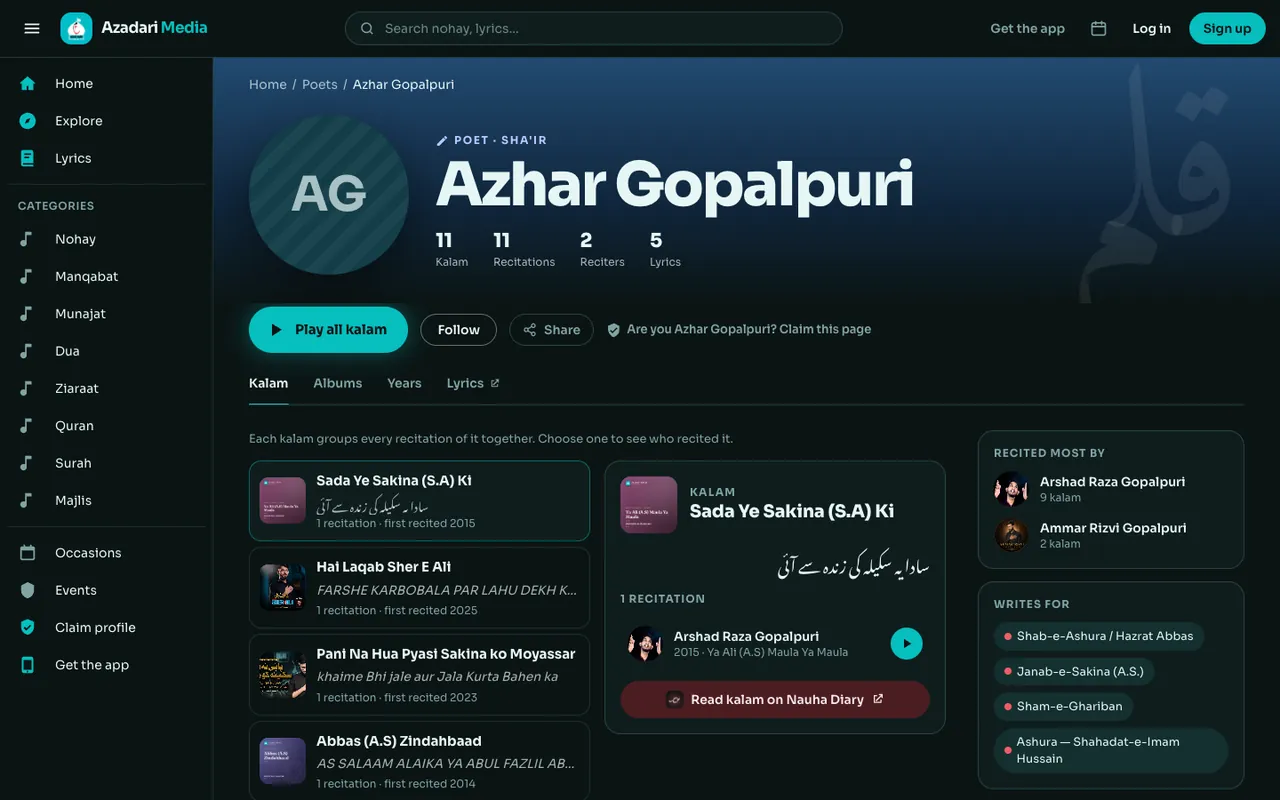
Poets: their kalam, and who recited it
Each kalam groups every recitation of it, so a poet’s words stay credited however many reciters perform them.
See a real example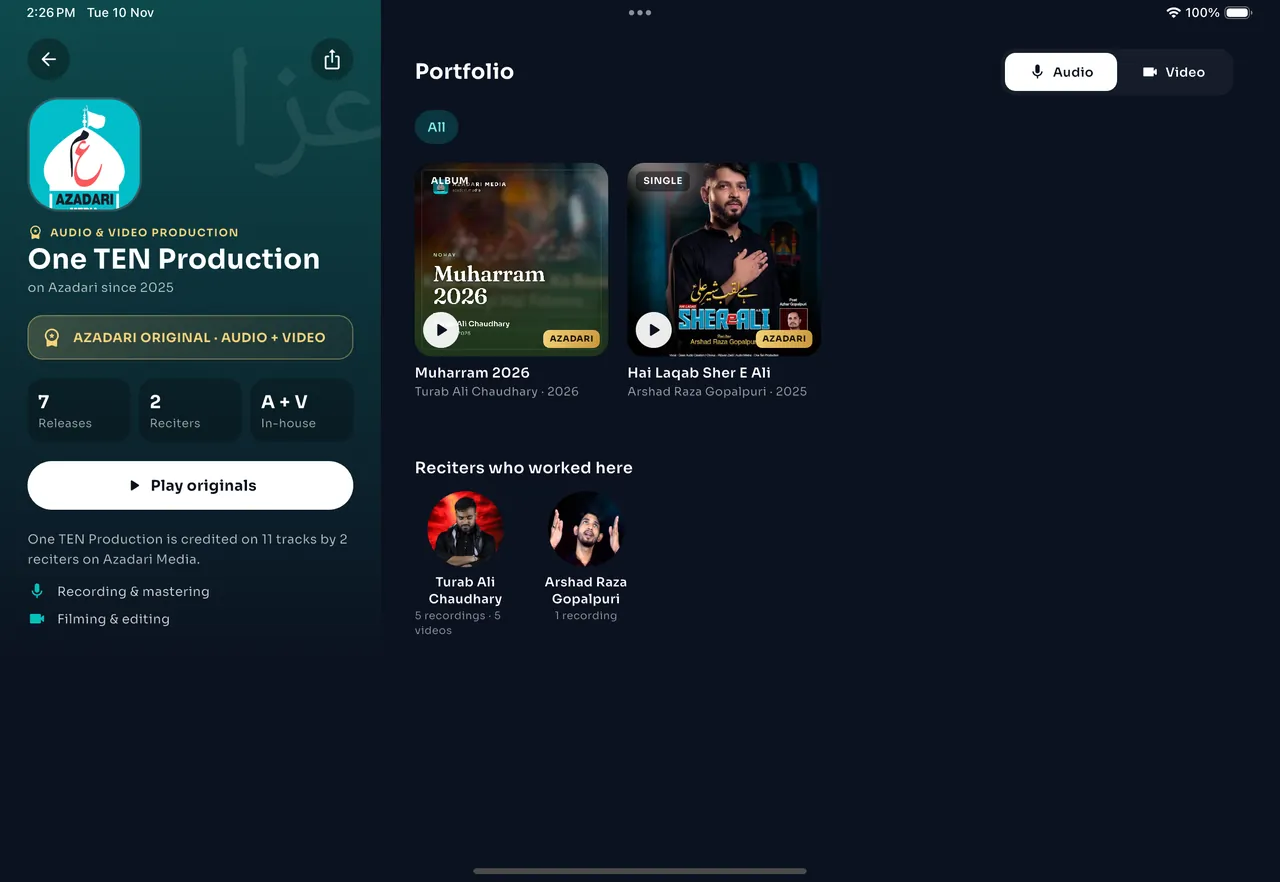
Studios and production houses: a portfolio
Recordings and videos they produced, and the reciters who worked with them, built from the credits on each track.
See a real example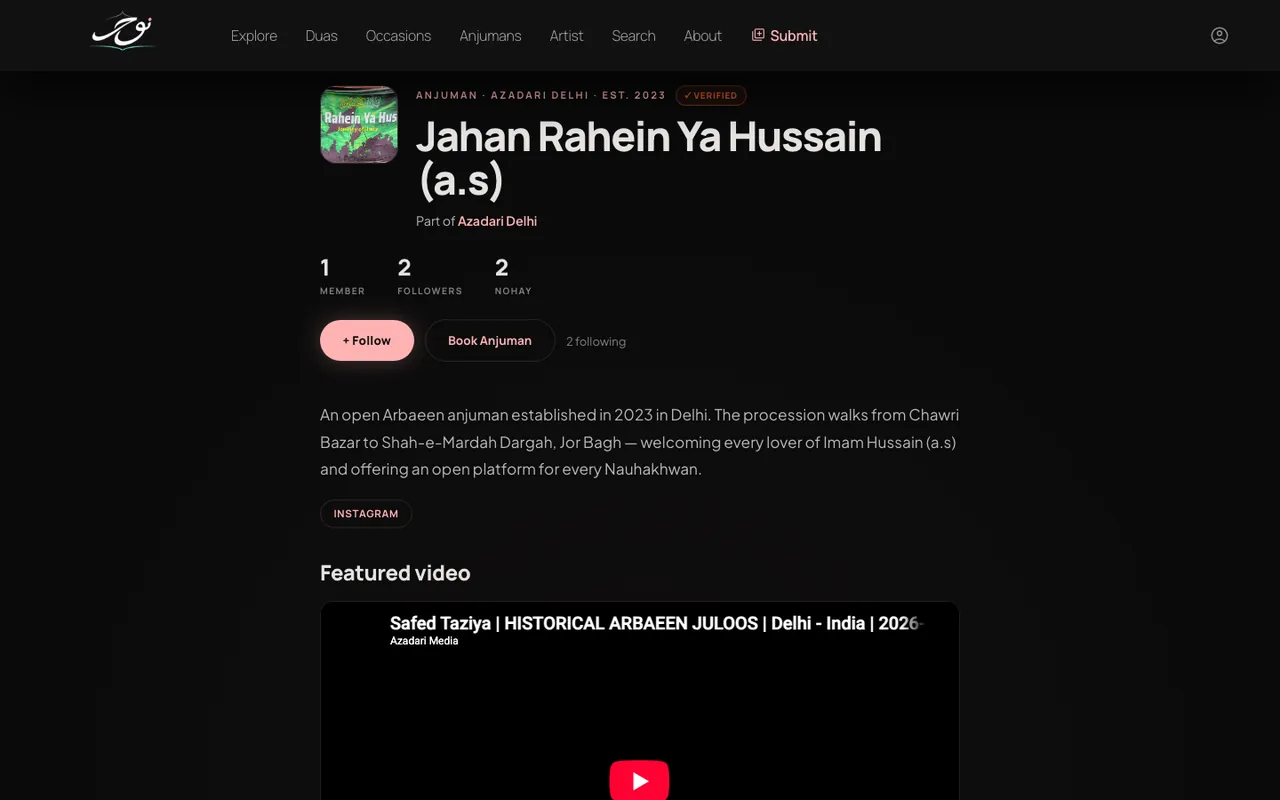
Anjumans: members, nohay, events
A page for your anjuman on Nauha Diary, grouped by city, with members, original nohay, events, followers and a Book button.
See a real example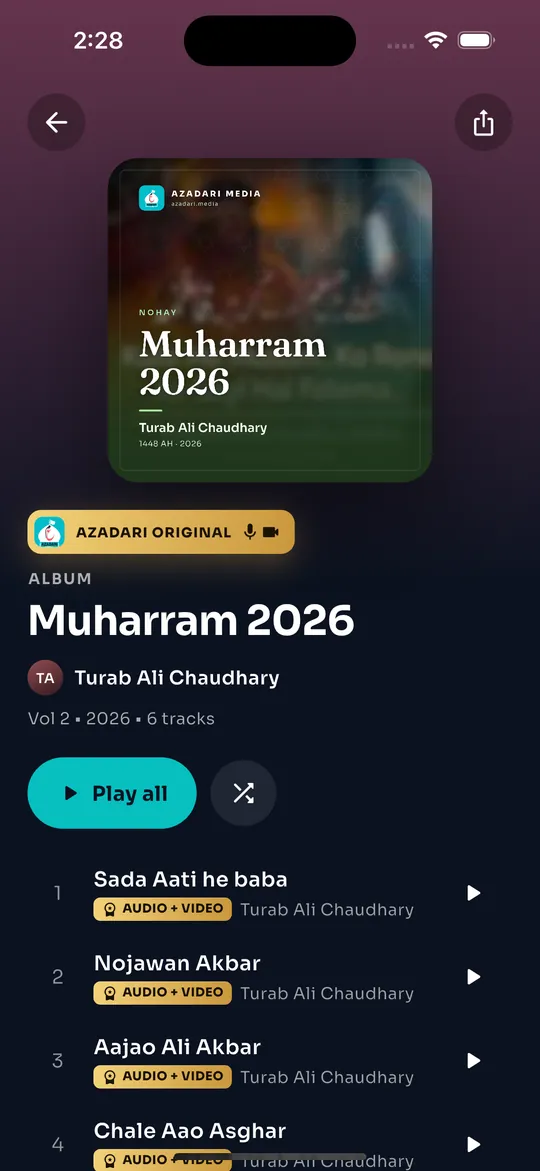
Albums: every track, every credit
Tracks in order with their credits, release year and cover. Azadari Originals carry their own badge.
See a real exampleMaking connections that matter
Consider a few everyday situations. A reciter wants to release a Muharram album but doesn’t know which studio to approach. A poet has written a kalam and wants to collaborate with a suitable reciter. A production house is looking for talented composers. An organiser wants to find and contact a reciter for an upcoming majlis.
Today, finding the right people often depends on personal networks and recommendations. What if all of this could happen in one organised place?
On Azadari Media, you can discover a creator, explore their portfolio, listen to their previous work, understand what they do and contact them directly. No endless searching. No need to know someone personally. Just meaningful connections between people who contribute to Azadari.
Preserving more than audio and video
One of our biggest motivations is preservation. Digital content can be uploaded, shared and lost among millions of other uploads. Preserving Azadari should mean more than keeping recordings online.
We should preserve the identity of the people behind those recordings. We should keep proper credits for poets, reciters, composers and production teams. We should make it possible for future generations to discover the people, works and contributions that shaped Azadari.
Imagine finding a nauha from decades ago and being able to explore its poet, its reciter, the studio that recorded it and their other works. Imagine a young reciter discovering the kalam of poets from earlier generations. Imagine an organised digital history that connects generations of creators.
That is the kind of preservation we believe in: not just preserving files, but preserving context, identity and legacy.
An ecosystem built around creators
Every creator deserves a professional identity, whatever the size of their audience. A well-established reciter and an emerging one should both have a place. An experienced poet and someone writing their first kalam should both be discoverable. A small recording studio and a large production house should both be able to show their work.
Azadari Media should not be a platform only for the already famous. It should help talented people become discoverable, encourage collaboration, recognise contributions and make opportunities easier to reach.
A better experience for listeners
Azadari Media is not only for the people who create. It is also for everyone who listens, discovers and connects with Azadari.
For millions of listeners, discovering a nauha is the beginning of a journey. They hear a beautiful kalam, connect with its words, appreciate the recitation and want to know more. Who wrote these words? Who recited them? Who composed the melody? Are there other works by the same poet or reciter? These answers are not always easy to find.
Imagine discovering a nauha and being able to see its complete credits, read its lyrics, meet the poet behind the kalam, explore the reciter’s portfolio and find their other works. Imagine discovering artists you have never heard before, and contributions from different generations.
Whether you come to discover a new nauha, read its lyrics, learn about a poet, explore a reciter’s work or revisit the legacy of an older generation, Azadari Media should be the place for that discovery. Because preserving Azadari also means making its history, creators and contributions accessible to everyone.
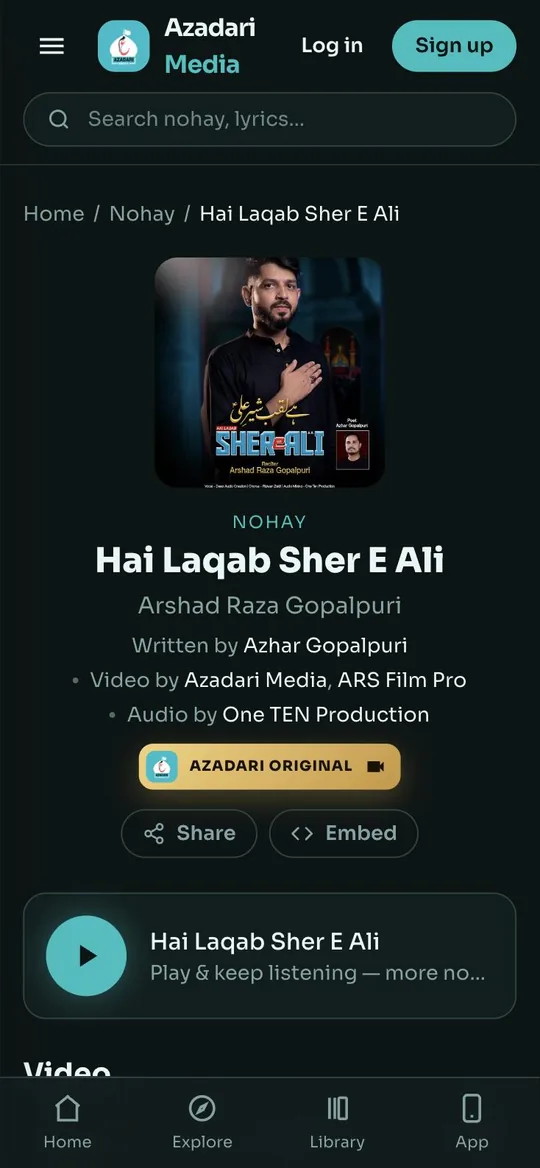
One nauha. Every name attached.
On YouTube this is one video. On Azadari Media it is a page that links to everyone who made it. Tap any name: each one has its own page.
So, why Azadari Media?
Existing platforms stay. We build what is missing around them.
YouTube
helps us watch.
Spotify, Apple Music & others
help us listen.
Azadari Media
connects the people behind the work: every nauha with its credits, every creator with a portfolio, every contribution with a place.
Our vision
We picture a future where asking someone “Are you on Azadari Media?” becomes a natural part of the community. Where a reciter shares their profile instead of only a social media handle. Where a poet’s work is properly credited and discoverable. Where studios and production houses connect directly with creators. Where the history and contributions of Azadari stay organised and accessible for generations to come.
Because Azadari is not built by content alone. It is built by people: their dedication, their creativity and their contributions.
Where we are today
- 4,800+ nohay from 490+ reciters, free to listen
- Lyrics next to the audio, many synced line by line
- Reciter profiles that reciters can claim, with a Book Me button
- Poet, audio and video credits on tracks and albums
- Free Creator Studio, and a manager role for studios and labels
- Occasions, duas, ziyarat and majalis listings
- Anjuman pages on Nauha Diary: members, original nohay, events and bookings
- Full portfolios for poets, composers, studios and production houses
- Discover and contact collaborators by role and city
- Credits for older recordings, added generation by generation
Giving Identity to Every Contribution. Preserving the Legacy. Connecting the Creators.
Questions
How is Azadari Media different from YouTube and Spotify?
YouTube helps you watch and Spotify helps you listen. Neither was built to keep the credits of a nauha: who wrote it, who recited it, which studio made it, and for which occasion. Azadari Media organises every nauha around those people. Each reciter and poet has one profile with their complete work, the lyrics sit next to the audio, and you can browse by occasion and Hijri date. It works alongside YouTube and Spotify, not instead of them.
What is Azadari Media?
Azadari Media is a free, complete digital home for Azadari: nohay (nauha), marsiya, manqabat, majalis, duas and ziyarat, the reciters and poets behind them, and Azadari events. It has 4,800+ recitations from 490+ reciters, each on its own page with the lyrics, the reciter, the poet where known, the album, the year and the occasion. It is also a home for the people who create Azadari, with free profiles for reciters, poets and studios. You listen at azadari.media, on Android, Android TV, Wear OS and Windows.
I am a reciter. How do I get my nohay on Azadari Media?
Use the free Creator Studio at studio.azadari.media or the Azadari Studio app for Android. If your nohay are already on Azadari Media, claim your profile; if not, create one. After a quick check by our team you can upload albums and tracks, add lyrics and credits, and see who is listening.
Listen, read along, discover
4,800+ nohay, free, no account needed.